
Most Football Manager players build tactics.
Elite players study the match engine.
In Football Manager 2026, the match engine isn’t just a visual simulation. It’s a layered decision-making system built around positioning logic, risk evaluation, space occupation, and contextual reactions.
If your tactic “works sometimes,”
If your team dominates xG but loses 1-0,
If AI suddenly adapts and shuts you down…
This guide explains why.
Welcome to the complete FM26 Match Engine Masterclass.
1️⃣ The Core Truth: The Match Engine Is a Decision Simulator
FM26 doesn’t calculate outcomes randomly.
Every highlight you see is the result of:
Positioning calculations
Attribute-weighted decisions
Tactical instruction influence
Mental state modifiers
Risk vs reward probability
Think of it like this:
The engine constantly asks:
“Given this position, this player, this pressure level — what is the most logical decision?”
Understanding that logic changes how you build tactics.
2️⃣ Space Is the Real Attribute
Attributes matter.
But space matters more.
The engine heavily prioritizes:
Horizontal spacing
Vertical compactness
Passing lane availability
Defensive cover shadows
Numerical superiority zones
If your players are too close → passing congestion.
Too far apart → broken transitions.
Most tactical problems are actually spacing problems.
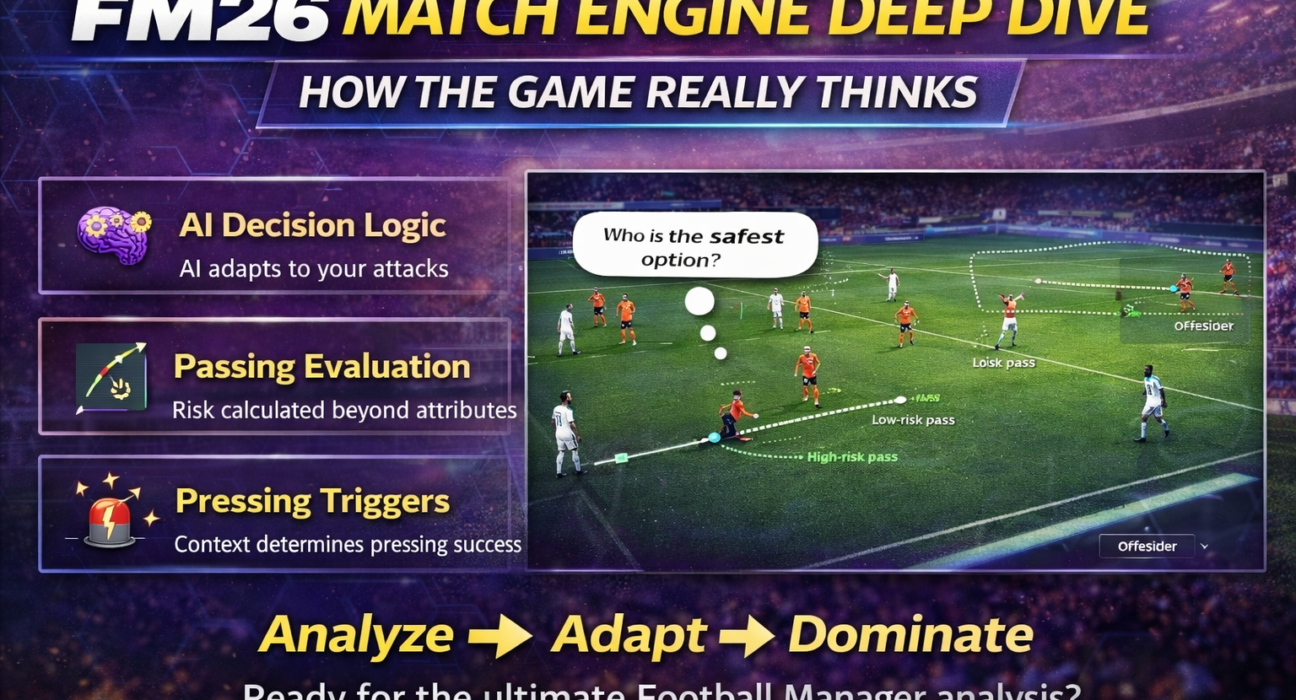
3️⃣ How FM26 Evaluates Passing Decisions
Passing in FM26 is not simply “Vision + Passing attribute.”
It includes:
Composure under pressure
Risk tolerance from team mentality
Role instruction freedom
Defensive proximity
Teammate body orientation
Why does your CM sometimes ignore the obvious through ball?
Because the engine likely calculated:
Defensive interception probability too high
Angle too narrow
Safer option available
This is why lowering tempo sometimes increases chance quality — it changes risk calculation pacing.
4️⃣ Defensive AI Logic: Why You Concede Certain Goals
The defensive engine runs on:
Marking priority
Zone responsibility
Line integrity
Triggered stepping-out logic
Common mistake:
High line + aggressive pressing + low cohesion = defensive desync.
CB steps forward.
Fullback tracks wide runner.
DM doesn’t cover gap.
Goal.
Not random. Structural.
5️⃣ Pressing Triggers – What Actually Activates Pressure
FM26 pressing is contextual, not constant.
The engine increases press probability when:
Opponent receives ball facing own goal
Touch is heavy
Passing lane closed
Support structure weak
It decreases pressing success when:
Player stamina low
Defensive line stretched
Teammates too far to support
That’s why pressing sometimes “dies” after 60 minutes even if you didn’t change anything.
Energy + spacing changed.
6️⃣ Transition Logic – The Hidden Decider of Matches
Transitions are where matches are won.
The engine recalculates positioning immediately after:
Possession loss
Interception
Clearance
Rebound
If your shape in possession leaves:
Both fullbacks high
DM roaming
CBs wide
You are vulnerable in the 2–3 seconds after losing the ball.
Most goals conceded are transition goals.
This is why dual-phase tactics matter so much in FM26.
7️⃣ Mental Attributes Matter More Than You Think
Under pressure moments (75th minute+), the engine increases weight on:
Composure
Decisions
Anticipation
Concentration
Low morale further reduces these effective values.
That’s why elite squads close games better.
Late goals are often psychological engine calculations, not tactical flaws.
8️⃣ AI Adaptation – Does the Engine Counter You?
Short answer: Yes, indirectly.
The AI doesn’t “cheat.”
But it does:
Adjust pressing intensity
Exploit overload zones
Shift defensive line
Target isolated defenders
If you consistently attack left side:
AI increases defensive density there.
If your striker drops deep constantly:
CB marking behavior changes.
Static tactics are easier to neutralize.
Subtle in-game tweaks matter.
9️⃣ Why xG Doesn’t Always Match Reality
xG in FM26 measures:
Shot quality
Location
Defensive proximity
It does NOT measure:
Player composure state
Fatigue
Morale
Defensive momentum
That’s why:
3.2 xG doesn’t guarantee 3 goals.
The engine calculates execution quality separately from chance quality.
🔟 The Three Engine Killers (What Breaks Tactics)
After thousands of simulated matches, most tactic failures come from:
❌ 1. Structural Imbalance
Too many attacking roles, not enough cover.
❌ 2. Spacing Collapse
Lines too stretched or too narrow.
❌ 3. Energy Decay
High-intensity system without rotation or stamina management.
Not bad ideas.
Bad structural sustainability.
11️⃣ Building Engine-Proof Tactics
To build tactics that survive AI adaptation:
✔ Maintain rest defense structure
✔ Avoid overloading one side constantly
✔ Keep one player behind ball in build-up
✔ Balance risk instructions
✔ Monitor fatigue trends
✔ Adjust mentality mid-game, not only roles
Consistency beats chaos.
Final Truth
The FM26 match engine rewards:
Structure
Logic
Spacing
Risk control
Psychological stability
It punishes:
Emotional tactical overreactions
Extreme systems without balance
Ignoring transitions
Once you stop fighting the engine and start understanding it…
You don’t just win more.
You dominate consistently.