
For years in Football Manager, building a tactic meant compromise.
You picked a formation.
You assigned roles.
You adjusted duties.
And then you hoped it would somehow work both with and without the ball.
In Football Manager 2026, that compromise is gone.
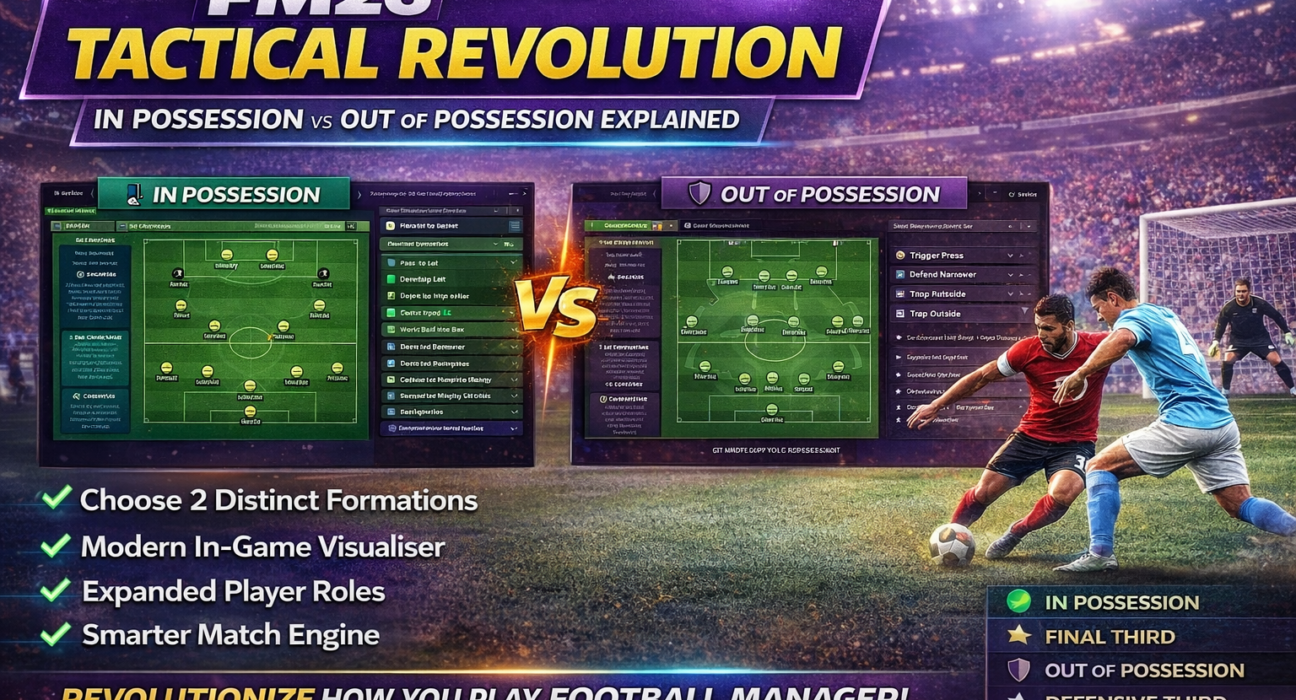
FM26 introduces a true tactical split between In Possession and Out of Possession — and this isn’t just a UI tweak. It fundamentally changes how you build teams, recruit players, and control matches.
Let’s break down why this is the biggest tactical shift we’ve seen in years.
The Problem FM26 Finally Solves
Modern football is not played in one static shape.
Manchester City build in a 3-2 structure.
Arsenal defend in a 4-4-2 mid-block.
Many teams attack in a 2-3-5 but defend in a compact 4-5-1.
Yet until now, FM forced us to define one base shape and stretch it across every phase of play.
That always felt artificial.
FM26 fixes this by letting you create:
One structure for when you have the ball
A completely different structure for when you don’t
And the difference is enormous.
Two Formations. One Tactical Identity
In FM26, you now define:
Your In Possession Shape
This is your attacking blueprint.
How do you build up?
How many players attack the box?
Who holds width?
Who drops deep?
This is where you design your offensive structure — whether that’s positional play, direct vertical transitions, or overload-heavy wing attacks.
Your Out of Possession Shape
This is your defensive personality.
Do you press high?
Do you drop into a compact mid-block?
Do you force play wide?
Do you protect the half-spaces?
Instead of hoping your attacking formation “sort of” becomes compact defensively, you now explicitly define it.
That alone removes a massive tactical limitation from previous editions.
The Visualiser: Finally Seeing What Your Tactic Actually Does
One of the smartest additions in FM26 is the upgraded tactical visualiser.
Instead of guessing how your roles interact, you can now:
Preview positioning across different areas of the pitch
See how players transition between phases
Understand spacing before kickoff
This is huge.
In previous versions, managers often built tactics based on theory — only to discover strange spacing issues in match highlights.
Now you can see structural problems early.
That means fewer “Why is my DM standing there?” moments.
Roles Now Make More Sense
FM26 also rethinks player roles in a subtle but important way.
Players now behave differently depending on phase of play.
This means:
Your full-back might invert in build-up
But defend wide when out of possession
Your striker might press aggressively
But drop into channels during build-up
Instead of being locked into rigid “Attack / Support / Defend” presets, players operate in a more fluid, context-aware way.
It feels more like coaching — less like toggling settings.
Why This Changes Recruitment Strategy
This update doesn’t just affect tactics. It changes squad building. In older versions, you mainly evaluated:
Role suitability
Attributes
Traits
Now you must think about:
Can this player function in two structural contexts?
Does he have the tactical intelligence to adapt?
Can he press intensely and still contribute in build-up?
A technically gifted but lazy winger might thrive in possession but break your pressing structure.
A disciplined but limited midfielder might stabilize defense but slow your attacking transitions.
FM26 forces you to think more holistically.
And that’s a good thing.
For more reading take a look at our recruitment guide
The Match Engine Feels Smarter
The tactical split would mean nothing without match engine support.
Thankfully, FM26 integrates:
Smarter defensive positioning
Improved off-ball movement
Better pressing logic
More realistic passing decisions
When your out-of-possession structure works, you feel it.
When your build-up spacing is wrong, you see it immediately.
The connection between tactical planning and on-pitch results feels tighter than before.
The Hidden Advantage: Tactical Clarity
One underrated benefit of this system is clarity.
In older versions:
You sometimes fixed defensive problems by adjusting attacking roles.
Or patched attacking issues by tweaking pressing intensity.
It felt reactive.
Now, problems are easier to isolate:
Conceding transitions? Check your out-of-possession shape.
Struggling to break low blocks? Rework your in-possession spacing.
Players disconnected? Analyze structural gaps.
This separation makes managers more deliberate.
And more intelligent in their adjustments.
Is This More Complex?
Yes.
But it’s not confusing.
If anything, it removes artificial complexity.
Instead of stacking instructions on top of each other to “fake” structural behavior, you now design it intentionally.
That’s cleaner.
And closer to real football.
The Bigger Picture
FM26’s In Possession vs Out of Possession system isn’t just a new feature.
It’s a philosophical shift.
It recognizes that football is dynamic.
That shape is fluid.
That structure changes with context.
For experienced players, this is the most refreshing tactical development in years.
For newer managers, it might take a few matches to understand.
But once it clicks?
You’ll never want to go back to a single static formation again.