
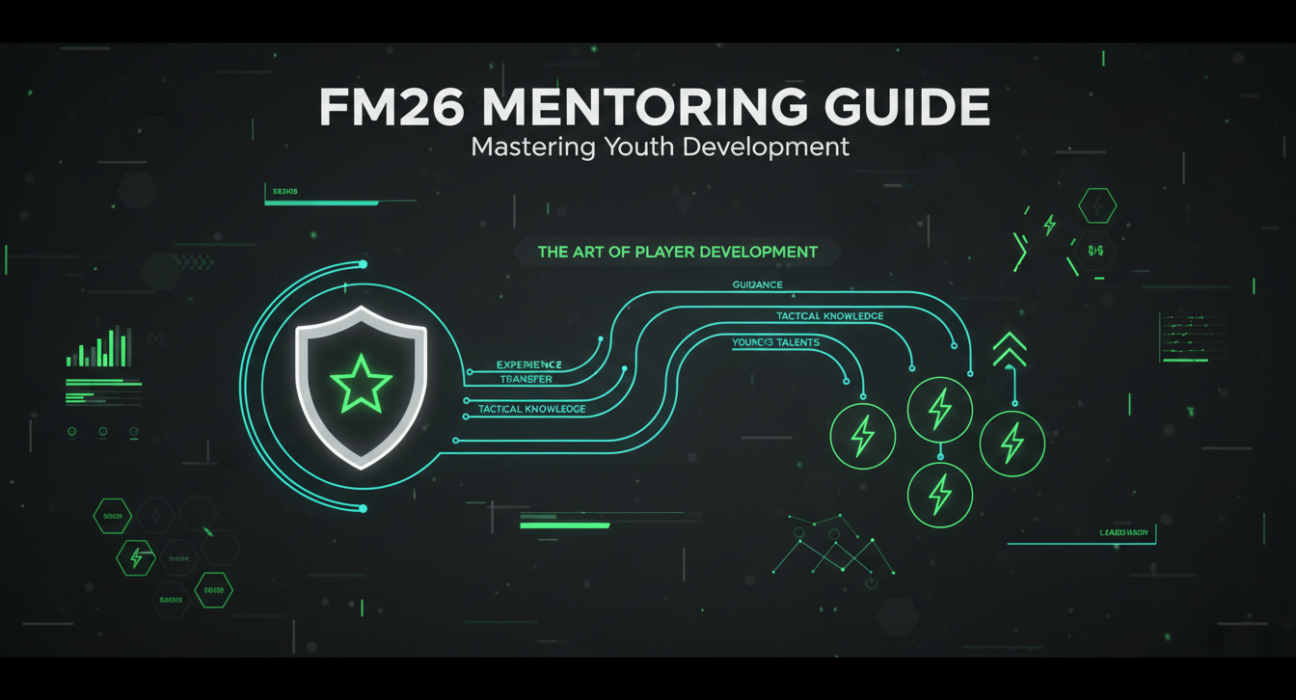
FM26 Mentoring Guide: In Football Manager 2026, developing young players is no longer just about training intensity or match minutes.
The FM26 development model rewards structure, mentality, and professionalism more aggressively than ever before.
A 5-star potential wonderkid does not automatically reach his ceiling.
The difference between a world-class star and a stalled prospect often comes down to one system:
Mentoring.
This guide breaks down FM26 mentoring at a technical level:
What mentoring actually changes
Why Professionalism is the hidden engine of development
How to select the right mentor
How to structure mentoring groups
Loan vs mentoring decisions
The ideal age window for influence
Hidden attributes impact
How to build a long-term mentoring culture
This is not a surface guide.
This is how you build dynasties.
1️⃣ Why the FM26 Mentoring Guide Is Essential for Player Development
Player development in FM26 is influenced by five core factors:
Professionalism (hidden attribute)
Determination
Training facilities
Coaching quality
Match experience
Most managers focus only on facilities and coaching.
But FM26 introduced a critical shift:
Professionalism now directly affects attribute growth speed.
High Professionalism leads to:
✔ Higher training ratings
✔ Faster attribute growth
✔ Greater development stability
✔ Fewer stagnation periods
Low Professionalism results in:
❌ Inconsistent training
❌ Slower development
❌ Failure to reach potential
Mentoring exists to influence this invisible foundation.
Mentoring does not directly increase attributes.
It multiplies development efficiency.
2️⃣ Understanding Personality Types in FM26
Personality labels are not cosmetic. They reflect hidden attributes.
Elite Personalities
Model Citizen
Model Professional
Professional
Resolute
Perfectionist
Players with these personalities:
Train harder
Develop more consistently
Perform better under pressure
Risk Personalities
Casual
Unambitious
Low Determination
Temperamental
Slack
These players:
Struggle with training consistency
Are prone to stagnation
May never hit their full potential
A technically gifted 17-year-old with a Casual personality may grow slower than a 3-star prospect with Model Professional.
Mentoring reshapes that trajectory.
3️⃣ What Mentoring Actually Influences
In FM26, mentoring impacts four major areas:
Determination
Personality
Media handling style
Hidden mental attributes (especially Professionalism)
Important:
Mentoring does not directly increase technical attributes.
It enhances the mental foundation that allows attributes to grow faster.
Think of it as:
Not a stat boost —
A growth accelerator.
4️⃣ How to Choose the Right Mentor
The ideal mentor should have:
✔ Determination 14+
✔ High Professionalism
✔ Squad Leader or Highly Influential status
✔ Age between 28–33
✔ Regular playing time (preferable)
Common mistake:
Assigning an aging squad player with no influence as a mentor.
If the player has no dressing room authority, his mentoring impact will be weak.
Hierarchy matters in FM26.
5️⃣ How to Structure Mentoring Groups
Optimal structure:
1 mentor
2 (maximum 3) young players
Why small groups?
Because personality influence spreads thinner in larger groups.
Smaller groups = stronger personality transfer.
For best results:
Similar positions
Similar tactical roles
Similar responsibility levels
Example:
Anchor → young DM
Advanced Playmaker → young AP
Position alignment is not mandatory but improves development synergy.
6️⃣ The Ideal Age Window for Mentoring
Age 16–17
Adapting to professional environment
Personality still flexible
Mentoring should be cautious
Age 18–20 (Golden Window)
Personality still moldable
Determination can rise
Strongest mentoring impact
Age 21+
Personality mostly fixed
Limited influence possible
The prime mentoring window is 18–20.
After 21, the influence curve drops sharply.
7️⃣ Combining Mentoring with Training
Mentoring alone does not create elite players.
The most effective development system combines:
Individual role training
Additional focus (Quickness, Strength, etc.)
High-level coaching staff
Good training facilities
Controlled but consistent match exposure
When Professionalism improves:
Training ratings rise.
Attribute growth accelerates.
Mentoring strengthens the engine behind the numbers.
8️⃣ Mentoring & Hidden Attributes
FM26 contains hidden attributes that strongly affect performance:
Professionalism
Ambition
Consistency
Big Matches
Pressure Handling
Mentoring can influence these indirectly.
Especially Professionalism.
Example:
A young player with low professionalism
+
Two seasons under a Model Professional mentor
Noticeable personality shift possible
This often unlocks stalled potential.
9️⃣ Loan vs Mentoring – What’s Better?
Keep & Mentor If:
You can give 20+ matches per season
Training facilities are strong
Coaching quality is elite
First team exposure + mentoring is ideal.
Loan If:
The player would be a bench option
Minutes are limited
Development would stagnate
But be careful:
The loan club’s personality culture matters.
Sending a low professionalism player to a poorly structured club can backfire.
🔟 Common Mentoring Mistakes
❌ Using low-determination players as mentors
❌ Large mentoring groups
❌ Ignoring squad hierarchy
❌ Not reviewing mentoring progress every 6 months
❌ Mixing drastically different personalities in one group
Mentoring is dynamic.
It must be monitored.
11️⃣ Position-Based Mentoring Strategy
Different positions require different mental strengths.
Centre-Backs
Leadership
Positioning intelligence
Big match temperament
Defensive Midfielders
Decisions
Positioning
Work rate
Central Midfielders
Composure
Decision-making
Professionalism
Wingers
Work rate
Determination
Mental resilience
Strikers
Composure
Anticipation
Big match performance
A structured mentoring plan considers positional psychology.
12️⃣ Long-Term Mentoring Culture
Clubs that systematically use mentoring gain:
✔ Stable dressing rooms
✔ Fewer morale collapses
✔ Sustainable success
✔ Reduced transfer dependency
True dominance in FM26 is cultural, not tactical.
Tactics win matches.
Culture wins eras.
Mentoring builds culture.
13️⃣ FM26 Mentoring Meta Summary
The winning formula in FM26:
High Professionalism core
Balanced age curve
Structured mentoring chains
Elite training environment
Mentoring correctly implemented:
Unlocks wonderkid ceilings.
Creates consistent performance.
Builds long-term dominance.
Used incorrectly:
Leaves potential unrealized.
FAQ – FM26 Mentoring Guide
Does mentoring increase attributes in FM26?
No. Mentoring improves personality and professionalism, which indirectly speeds up attribute growth.
What is the best age for mentoring in FM26?
Between 18–20 years old.
Can mentoring change professionalism in FM26?
Yes, indirectly through personality influence.