

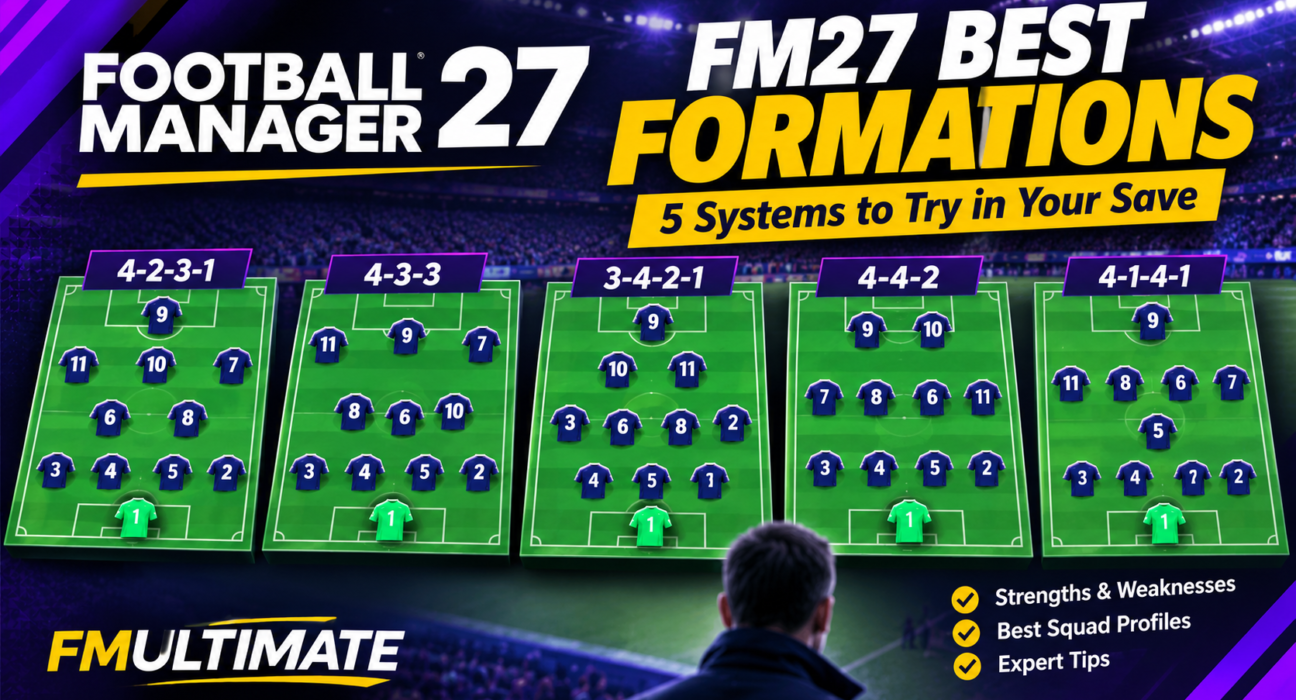
Choosing the right formation is one of the first major decisions you make when taking charge of a new club in Football Manager 27. But a formation is much more than a collection of numbers on a tactics screen. It determines how your team creates space, controls midfield, presses opponents and protects its own goal.
FM27 makes tactical planning even more important. With Tactical Effectiveness and Tactical Complexity influencing how well your players execute your ideas, choosing a system that suits your squad can make a significant difference.
There is no universally perfect formation. A system that works brilliantly with a technically gifted top-flight squad might expose the weaknesses of a newly promoted team.
In this guide, we look at five formations worth trying in FM27, explain their strengths and weaknesses, and identify the type of squad that can get the most out of each one.
1. 4-2-3-1: The Balanced Attacking Formation
The 4-2-3-1 remains one of the most versatile starting points for managers who want a combination of attacking threat and midfield protection.
With four defenders, two deeper midfielders, three attacking midfielders and a lone striker, it offers several passing options while maintaining a relatively balanced structure.
How Does the 4-2-3-1 Work?
The two deeper midfielders provide the foundation of the system. One can focus on protecting the defence and maintaining positional discipline, while the other helps progress possession and connect with the attacking players.
Ahead of them, the central attacking midfielder operates between the opposition’s midfield and defensive lines. The two wide attackers provide width, carry the ball forward and support the striker.
Your full-backs can also contribute to attacks, although their positioning needs to be balanced against the defensive responsibilities of the midfield pair.
Key player profiles:
- Two reliable central midfielders with good positioning and decision-making.
- A creative attacking midfielder who can operate between the lines.
- Wide attackers with pace, dribbling and intelligent movement.
- A striker capable of holding up play or attacking space behind the defence.
Strengths:
- Good attacking support around the striker.
- Multiple options for progressing the ball.
- A natural structure for pressing and counter-attacking.
- Flexibility to adjust the attacking and defensive approaches.
Weaknesses:
- The lone striker can become isolated if the attacking midfielder is ineffective.
- The space behind attacking full-backs can be exploited.
- The two central midfielders may struggle against teams using three central midfielders.
Best suited for: Teams with a quality number ten, strong wide attackers and two dependable central midfielders.
Our verdict: If you are unsure where to begin, the 4-2-3-1 is a sensible option. It offers a familiar structure without forcing you into an overly complicated tactical approach.
2. 4-3-3: The High-Pressing and Possession System
If you want your team to dominate possession, press aggressively and create attacking opportunities through a front three, the 4-3-3 is worth considering.
Its biggest advantage is the midfield structure. Three central midfielders can provide different passing angles, protect the centre of the pitch and support attacks from deeper positions.
How Does the 4-3-3 Work?
The midfield usually consists of one deeper player and two more advanced midfielders.
The deeper midfielder provides defensive cover and helps circulate possession. The other two midfielders can move into advanced positions, support the forwards and press the opposition.
Up front, the wide attackers stretch the opposition defence while the central striker occupies the centre-backs.
A well-balanced 4-3-3 can create overloads in midfield without sacrificing attacking width.
Key player profiles:
- A disciplined defensive midfielder with strong positioning.
- Two mobile central midfielders with good work rate and passing ability.
- Wide forwards who can beat opponents and contribute defensively.
- A striker who can press, link play and attack the penalty area.
- Centre-backs comfortable defending space behind a higher defensive line.
Strengths:
- Strong midfield presence.
- Natural attacking width.
- Good structure for coordinated pressing.
- Multiple options for creating chances through central and wide areas.
Weaknesses:
- The space behind the defensive line can become a problem.
- The midfield can lose its balance if both advanced midfielders move forward simultaneously.
- High pressing can place significant physical demands on the squad.
- A lack of suitable midfield depth can become costly over a long season.
Best suited for: Stronger teams with technically capable midfielders, energetic forwards and centre-backs comfortable defending higher up the pitch.
Our verdict: The 4-3-3 is a strong option if your squad has the technical quality and physical condition to support an aggressive approach. Do not choose it simply because you want to dominate possession. Your players must be able to sustain the system.
3. 3-4-2-1: The Flexible Back-Three System
The 3-4-2-1 offers a different approach to building your team. Instead of relying on traditional full-backs, it uses three central defenders and two wide players who provide width in both attacking and defensive phases.
It can be particularly useful for teams that have several quality centre-backs but lack natural full-backs.
How Does the 3-4-2-1 Work?
Three centre-backs provide the defensive foundation, while the two wide players operate as wing-backs.
In attack, the wing-backs can push forward to create width. The two attacking midfielders operate behind the striker, looking for space between the opposition’s defensive and midfield lines.
The central midfield pairing needs to provide balance. One player can focus on protecting the defence, while the other supports possession and transitions.
The system can also create a compact defensive structure when the team drops deeper.
Key player profiles:
- Three centre-backs with good positioning and communication.
- Two wing-backs with excellent stamina and work rate.
- A balanced central midfield partnership.
- Two creative attacking midfielders who can support the striker.
- A forward capable of linking play and attacking space.
Strengths:
- Strong central defensive coverage.
- Natural width through the wing-backs.
- Two attacking midfielders can create problems between the lines.
- Useful for teams that prefer to defend compactly and attack quickly.
Weaknesses:
- Wing-backs have demanding physical responsibilities.
- The central midfield can be outnumbered by certain opponents.
- The system relies heavily on suitable wide players.
- The attacking midfielders may become disconnected from the striker.
Best suited for: Teams with three capable centre-backs, energetic wing-backs and creative attacking midfielders.
Our verdict: The 3-4-2-1 is an interesting option for managers who want a compact defensive foundation without sacrificing attacking support. It can also provide a useful alternative when your squad has more quality centre-backs than full-backs.
4. 4-4-2: The Classic Two-Striker Formation
Sometimes a simpler approach is exactly what your team needs.
The 4-4-2 remains a useful formation for managers who want a clear defensive structure, direct attacking options and two forwards working together.
It is particularly interesting for lower-league clubs where squad limitations can make complicated tactical systems difficult to implement.
How Does the 4-4-2 Work?
The formation uses two banks of four, creating a straightforward defensive structure.
The wide midfielders provide support in both directions, while the central midfield pairing is responsible for controlling the middle of the pitch.
The two strikers offer different attacking possibilities. One can focus on holding up the ball and bringing teammates into play, while the other looks to attack space and finish chances.
The exact combination depends on your available players.
Key player profiles:
- Two centre-backs comfortable defending crosses and direct attacks.
- Wide midfielders with good stamina and defensive work rate.
- Central midfielders who can compete physically and maintain possession.
- Two complementary strikers with different strengths.
Strengths:
- Simple structure that is relatively easy to understand.
- Two forwards provide immediate attacking options.
- Useful for direct football and quick transitions.
- Clear defensive responsibilities.
Weaknesses:
- Can be outnumbered by teams using three central midfielders.
- Wide midfielders have significant defensive responsibilities.
- The central midfield partnership must cover a lot of ground.
- Can become predictable without good movement from the forwards.
Best suited for: Lower-league clubs, teams with two good strikers and managers who prefer a direct, straightforward approach.
Our verdict: Do not underestimate the 4-4-2. It may lack some of the positional flexibility of more modern systems, but it can be an effective starting point when your squad has the right player profiles.
5. 4-1-4-1: The Compact Defensive System
Not every match should be approached with an attacking mentality.
If you are managing an underdog, playing away against a stronger opponent or trying to protect a narrow lead, the 4-1-4-1 offers a compact structure that can help your team defend central areas.
It provides a single defensive midfielder in front of the back four and another line of four players ahead of him.
How Does the 4-1-4-1 Work?
The defensive midfielder protects the space in front of the centre-backs and helps prevent opponents from finding easy passing routes through the middle.
The four midfielders ahead of him provide support across the pitch. They can close passing lanes, challenge for second balls and help the team transition into attack.
The lone striker leads the attacking line, so his ability to hold up the ball and bring teammates forward can be especially important.
This formation does not have to be purely defensive. With the right wide players and midfield runners, it can also create dangerous counter-attacks.
Key player profiles:
- A disciplined defensive midfielder with strong positioning and defensive awareness.
- Two central midfielders capable of covering ground.
- Wide midfielders who can track runners and transition quickly.
- A striker who can operate without constant support.
Strengths:
- Compact central defensive structure.
- Good protection for the centre-backs.
- Useful against stronger possession-based opponents.
- Provides a solid foundation for counter-attacking football.
Weaknesses:
- The striker can become isolated.
- Creating chances may be difficult against deep defensive blocks.
- The team can spend long periods without possession.
- Wide midfielders need to contribute consistently in both phases.
Best suited for: Underdogs, away matches against stronger teams and clubs that need a more cautious approach.
Our verdict: The 4-1-4-1 is a useful alternative when defensive stability is your priority. It is not simply a formation for sitting deep; it can also help you build a disciplined team that attacks quickly when opportunities appear.
FM27 Best Formations Compared
Here is a quick comparison to help you decide which system fits your squad.
| Formation | Main Strength | Main Weakness | Best For |
|---|---|---|---|
| 4-2-3-1 | Attacking balance | Isolated striker | Balanced squads |
| 4-3-3 | Pressing and possession | Space behind the defence | Stronger teams |
| 3-4-2-1 | Compact defensive structure | Wing-back demands | Teams with three quality centre-backs |
| 4-4-2 | Direct attacking play | Midfield numbers | Lower-league teams |
| 4-1-4-1 | Defensive compactness | Limited attacking support | Underdogs |
How to Choose the Right Formation in FM27
Knowing the strengths of each formation is useful, but choosing the right one for your club requires a little more thought.
Before settling on a system, consider these five factors.
1. Start With Your Best Players
Look at your strongest players before choosing a formation.
If your best player is an attacking midfielder, a 4-2-3-1 may help you build around him. If you have three excellent centre-backs and energetic wing-backs, a 3-4-2-1 could make better use of your squad.
Do not force a formation simply because it is popular.
2. Consider Your Squad’s Tactical Ability
FM27’s Tactical Effectiveness system connects your team’s ability, understanding, buy-in and preparation for the next match.
A complicated system may take longer to implement, particularly if your players lack the attributes or experience required to execute it.
You can read more about this in our FM27 Best Tactics guide
3. Match Your Defensive Line to Your Centre-Backs
Your preferred formation should also reflect the defensive capabilities of your players.
If your centre-backs have good pace and anticipation, a higher defensive line may be an option. If they struggle to recover against quick forwards, a more cautious approach could be appropriate.
The formation alone does not determine how safely your team defends.
4. Think About Stamina and Squad Depth
Some formations place greater physical demands on players than others.
A high-pressing 4-3-3 and a wing-back-heavy 3-4-2-1 require players who can repeatedly cover large distances.
If your squad lacks depth, consider how your formation will perform across a full season rather than just one match.
5. Give Your Formation Time to Develop
One poor performance does not mean your formation is wrong.
Give your players time to understand their responsibilities, use training to support your tactical approach and look at match data before making major changes.
FM27’s official Training and Tactical Effectiveness feature guide explains how training, tactical understanding and player ability influence the effectiveness of your system.
Final Thoughts: There Is No Perfect Formation in FM27
The best formation in Football Manager 27 is not necessarily the one that looks most attacking or uses the most complicated instructions.
It is the system that allows your players to perform their roles, makes the most of your strongest qualities and protects your weaknesses.
The 4-2-3-1 offers a balanced starting point, the 4-3-3 suits teams built around pressing and possession, while the 3-4-2-1 provides an alternative defensive structure. The 4-4-2 remains a practical option for direct football, and the 4-1-4-1 can help underdogs remain compact against stronger opponents.
Try different systems, analyse your performances and avoid changing your entire approach after every defeat.
Most importantly, build a formation around your players rather than trying to make your players fit a formation.
Looking for your next FM27 challenge? Explore our FM27 Best Teams to Manage guide and find a club that suits your preferred style of football.