
Football Manager 27 introduces a new way to test your squad-building skills. Shuffle Draft takes the familiar idea of Fantasy Draft and adds rotating player pools, simultaneous picks and the option to reshape your team during a tournament.
Instead of spending hours building a squad through transfers, you have to make quick decisions with the players available to you. Every pick matters, every new round presents a different challenge, and your opponents are working with their own plans.
Whether you want to compete against friends, join an online tournament or experiment with players before signing them in Career Mode, FM27 Shuffle Draft offers a different kind of Football Manager challenge.
The key is knowing when to prioritise quality, when to fill a positional gap and when to think one step ahead of the other managers.
Here’s how Shuffle Draft works and how to approach your first event.
What Is Shuffle Draft in FM27?
Shuffle Draft is a new game mode in Football Manager 27, developed in partnership with FIFAe. It reworks the traditional Fantasy Draft format into a more dynamic experience built around changing groups of available players.
You can play online against other managers, create private events with friends or family, or play offline against AI-controlled teams. Public and private lobbies give you the option to join an existing event or create one with your preferred rules.
The main difference is how players are selected.
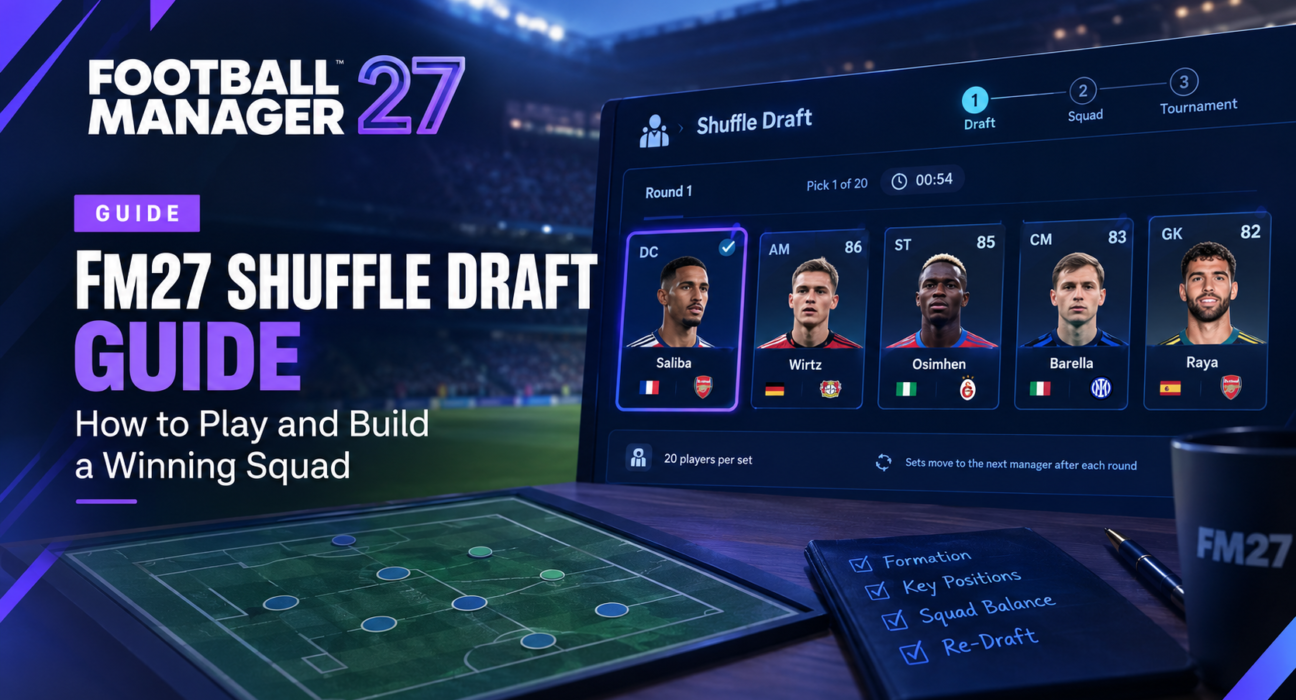
Rather than choosing from one fixed list, managers draft from sets of 20 players. Once everyone has made a selection, the sets move between managers for the next round. This means the players available to you change throughout the draft.
You need to think about your own squad, but you also need to adapt to the options presented in each round.
How Does Shuffle Draft Work?
A Shuffle Draft event follows three main stages: event setup, squad selection and the tournament itself.
1. Set Up Your Draft
The event host chooses the tournament format, squad size and player pool before the draft begins.
You can use preset player groups, build a custom pool or focus on particular player characteristics. This gives you considerable control over the kind of challenge you want to create.
For example, you could organise a draft centred on wonderkids, experienced veterans or the world’s best players. Alternatively, you could create a more specialised pool based on qualities such as physicality or leadership.
Player pools can also be configured around different levels of quality, helping you decide whether the event should feature a more balanced mix of players or focus on the elite.
One important restriction is that men’s and women’s players cannot be combined within the same Shuffle Draft event.
2. Draft Your Players
Each player set contains 20 players, and the number of sets corresponds to the number of participating teams.
Managers select one player from their current set within a time limit chosen by the host. Once everyone has made their pick, the sets move to another manager for the next round.
All managers make their selections simultaneously, so you don’t have to wait for every other participant to finish before making your own choice.
You can also bookmark players who interest you for future rounds. Your current squad remains visible during the process, making it easier to identify which positions still need attention.
This is where preparation and adaptability become equally important.
A world-class midfielder might look like an obvious selection, but if you still have no goalkeeper or reliable centre-back, another position could be more valuable.
3. Complete Your Squad and Prepare for the Tournament
Shuffle Draft supports four squad sizes:
- 14 players
- 16 players
- 18 players
- 20 players
Once the draft is complete, you can arrange your squad and set up your tactics before the tournament begins.
The match experience uses the same tactical setup and Match Engine available in FM27 Career Mode. That means your choices still need to make sense on the pitch, not just on the draft board.
A squad full of famous names is not automatically a balanced team. You still need a formation, complementary player roles and enough depth to cover the positions that matter to your system.
FM27 Shuffle Draft Tournament Formats
Shuffle Draft supports three tournament formats, allowing you to choose between a short knockout competition and a longer league campaign.
| Format | Team limit | Best suited to |
|---|---|---|
| Knockout Cup | 2–32 | Short, high-stakes competitions |
| Group Stage and Knockouts | 8, 16 or 32 | A group phase followed by elimination rounds |
| League | 2–20 | A longer competition where consistency matters |
You can fill empty places with AI managers, either to complete the tournament or to practise before playing against real opponents.
If you’re organising an event with friends, the best format depends on how much time everyone has. A knockout cup provides a straightforward competition, while a league gives managers more opportunities to recover from a poor result.
How to Build a Strong Shuffle Draft Squad
The most important skill in Shuffle Draft is recognising the difference between the best available player and the best pick for your team.
You have limited opportunities to build a squad, and the available choices change each round. A clear plan will help you avoid ending up with several excellent players who don’t fit together.
1. Decide on Your Formation Early
Before making your first selection, have a formation or tactical structure in mind.
You don’t need to commit to every instruction immediately, but you should know the basic shape you’re trying to build.
For example, a 4-3-3 requires suitable options across the front three and a midfield that can balance progression, creativity and defensive coverage. A 3-4-2-1 needs centre-backs who can operate in a back three, appropriate wide players and attacking midfielders who complement the striker.
These are not rigid rules. They are reminders that your early picks influence the choices you can make later.
With a smaller 14-player squad, positional planning becomes particularly important. A 20-player squad gives you more flexibility to select alternatives and adapt your system.
2. Prioritise the Positions That Are Hardest to Replace
Not every position needs to be filled in the first round, but leaving too many important roles until the end can create problems.
A useful starting point is to identify the players who will define your tactical system.
That could be a goalkeeper suited to your preferred build-up, a centre-back comfortable defending space, a midfielder who controls transitions or a forward who gives your attack a clear focal point.
Once those foundations are in place, you can look for complementary players.
Avoid drafting several players who perform similar functions simply because they have impressive reputations. A squad needs balance as well as individual quality.
3. Look Beyond Reputation
A familiar name can be tempting, especially when the selection timer is running down. However, reputation alone doesn’t tell you how useful a player will be in your system.
Consider the attributes and responsibilities associated with the role you want to fill.
For a high defensive line, recovery pace and defensive awareness may matter more than reputation. For a possession-based midfield, passing, decisions and technical quality could be more relevant to your plan.
The same principle applies to attacking players. A technically gifted creator and a forward who attacks space can complement each other more effectively than two players competing for the same areas.
Your aim should be to build a team, not a collection of individual highlights.
4. Use Bookmarks to Plan Ahead
Shuffle Draft allows you to bookmark players who catch your attention.
Use this feature to keep track of potential options rather than relying entirely on memory while the clock is ticking.
You might bookmark an alternative goalkeeper, a versatile defender or a midfielder who would fit a different tactical approach.
However, a bookmark is not a guarantee that you’ll get another opportunity to select that player. Other managers may pick them before the set reaches you again.
Treat bookmarks as part of your planning process, not as reserved selections.
5. Watch How Your Opponents Build Their Teams
Your opponents’ selections can provide useful clues about the direction of the draft.
If another manager is assembling a team around a particular style, you may be able to anticipate which positions or player profiles they will target next.
You can use that information to make more informed decisions about your own squad.
That doesn’t mean you should automatically select a player just to deny them to a rival. Sometimes the best decision is still to improve your own starting eleven.
The important thing is to understand that every selection happens in a competitive environment.
Choosing the Right Squad Size
The available squad sizes create a trade-off between specialisation and flexibility.
A 14-player squad rewards careful planning. With fewer places available, you have less room for unnecessary duplication, so each selection should have a clear purpose.
A 16-player squad provides a little more room for alternatives while still requiring a relatively focused approach.
An 18-player squad gives you additional options when adapting your tactical setup or covering different roles.
A 20-player squad offers the greatest flexibility. You can afford to consider more alternatives and may have more freedom to select an outstanding player even when the position isn’t your most urgent need.
These are strategic considerations rather than guaranteed outcomes. The ideal squad size also depends on the player pool, the tournament rules and your own tactical preferences.
If you’re new to Shuffle Draft, a smaller event with a clearly defined formation can be a useful way to learn the selection process.
Re-Draft: When Should You Replace a Player?
One of Shuffle Draft’s most distinctive features is Re-Draft.
Depending on the event settings, managers can return selected players to the draft pool or remove them from the tournament entirely, creating opportunities to reshape their squads after matchdays.
The host can configure up to five Re-Draft rounds, or disable the feature altogether. Each Re-Draft can include up to 20 player returns or removals in total.
This adds a new decision to the tournament: should you stick with your original plan or change direction based on how your team is performing?
When a Re-Draft Might Make Sense
Consider a change when a player no longer fits your tactical approach, a particular role is proving ineffective or your squad has an obvious imbalance.
For example, if your team consistently struggles to progress the ball through midfield, you might want to reassess the balance between your central players.
Likewise, if your attacking setup lacks a clear focal point, replacing a redundant option with a more suitable forward could be worth considering.
These are examples of situations to evaluate, not guaranteed solutions. A poor result alone doesn’t necessarily mean a player needs replacing.
Avoid Changing Your Team Without a Clear Reason
Re-Draft can be tempting after a disappointing performance, but changing too many players without identifying the underlying problem can make your squad less coherent.
Before returning anyone to the pool, ask yourself three questions:
- Is the problem caused by the player, their role or the overall tactic?
- Will the replacement address that problem?
- What other part of the team could be weakened by making this change?
A considered adjustment is generally more useful than rebuilding your squad after every defeat.
Do Players Get Tired in Shuffle Draft?
According to the official Shuffle Draft FAQ, player injuries and fatigue are removed before the next match.
This means managers begin each match with a fully fit squad, rather than having to manage accumulated fatigue in the same way as a conventional Career Mode save.
That changes the value of squad depth.
You should still select suitable alternatives for different positions and tactical situations, but you don’t need to approach the competition as though players will carry their fatigue from one fixture into the next.
It also means that choosing a player solely for their natural fitness or age is less important than it might be in a long-term career. Their attributes, role suitability and contribution to the team remain central to your decision.
Can You Use Shuffle Draft to Find Career Mode Signings?
Yes. Shuffle Draft can also be useful as a way to explore players before committing to them in a longer save.
You can see how different players work within a particular tactical setup and discover names you might not otherwise have considered.
For example, you could pay closer attention to how a midfielder contributes to your build-up or whether a forward suits the way you want to attack.
However, success in Shuffle Draft should not be treated as definitive evidence that a player will be an ideal signing in every Career Mode save. Your club, tactical system, available budget and the wider circumstances of a career will all affect the decision.
Think of Shuffle Draft as an additional way to explore player suitability, rather than a replacement for scouting and recruitment.
Common Shuffle Draft Mistakes to Avoid
If you want to build a more competitive squad, avoid these common traps.
Picking the biggest name every round. Individual quality matters, but a balanced team with complementary roles can be more useful than a collection of players who don’t fit together.
Ignoring your formation. You don’t need to lock yourself into a single system, but having no tactical direction can leave you with gaps that are difficult to fill.
Leaving essential positions too late. If the available choices become less suitable in later rounds, you may have to compromise elsewhere to repair the squad.
Forgetting about squad size. A 14-player squad requires different priorities from a 20-player squad. Plan your selections around the number of places available.
Using Re-Draft emotionally. One defeat doesn’t automatically mean your original selections were wrong. Identify the problem before replacing players.
Ignoring the other managers. The draft is competitive, and your opponents’ choices can affect which options remain available to you.
Is FM27 Shuffle Draft Worth Trying?
Shuffle Draft adds a different challenge to Football Manager 27 by placing more emphasis on squad construction, adaptability and quick decision-making.
It offers a way to compete against friends, test your ideas against other managers or experiment with different groups of players without committing to a full Career Mode save.
Its appeal will depend on what you enjoy about Football Manager. If you prefer long-term squad development, youth recruitment and building a club over several seasons, Career Mode will remain a different experience. If you enjoy tactical experimentation and the challenge of making the most of limited options, Shuffle Draft is worth exploring.
The most useful mindset is to approach each draft with a plan, remain flexible when the available players change and build a squad that makes sense on the pitch.
Because in Shuffle Draft, selecting the best players is only half the job. The real challenge is turning them into the best team.
Related FM27 Guides
- FM27: Everything We Know So Far
- FM27 vs FM26: What’s Actually Changing So Far?
- FM27 Deep Dives: A Better Interface and a More Immersive Football World
Football Manager 27 is scheduled to launch on 10 November 2026. Shuffle Draft details in this guide are based on Sports Interactive’s official announcement and FAQ and may be subject to change before release.